Gearjury may earn a commission when you buy through a retailer link. Safety figures follow cited public authorities.
Guide
Cooking Thermometer Temperature Chart for Meat and Food
For a simple Australian benchmark, FSANZ gives seventy-five degrees Celsius at the centre as one safe option for cooking potentially hazardous food. Some foods and processes use validated time-and-temperature alternatives.
GGearjury editorial team · Updated 15 October 2026· 5 min
01
Food thermometer chart: a practical benchmark
FSANZ says potentially hazardous food can be cooked to seventy-five degrees Celsius at the centre, or to an equivalent validated time-and-temperature combination. This broad benchmark is useful when a recipe or food-safety programme does not specify another validated process.
02
Poultry, mince and rolled meat
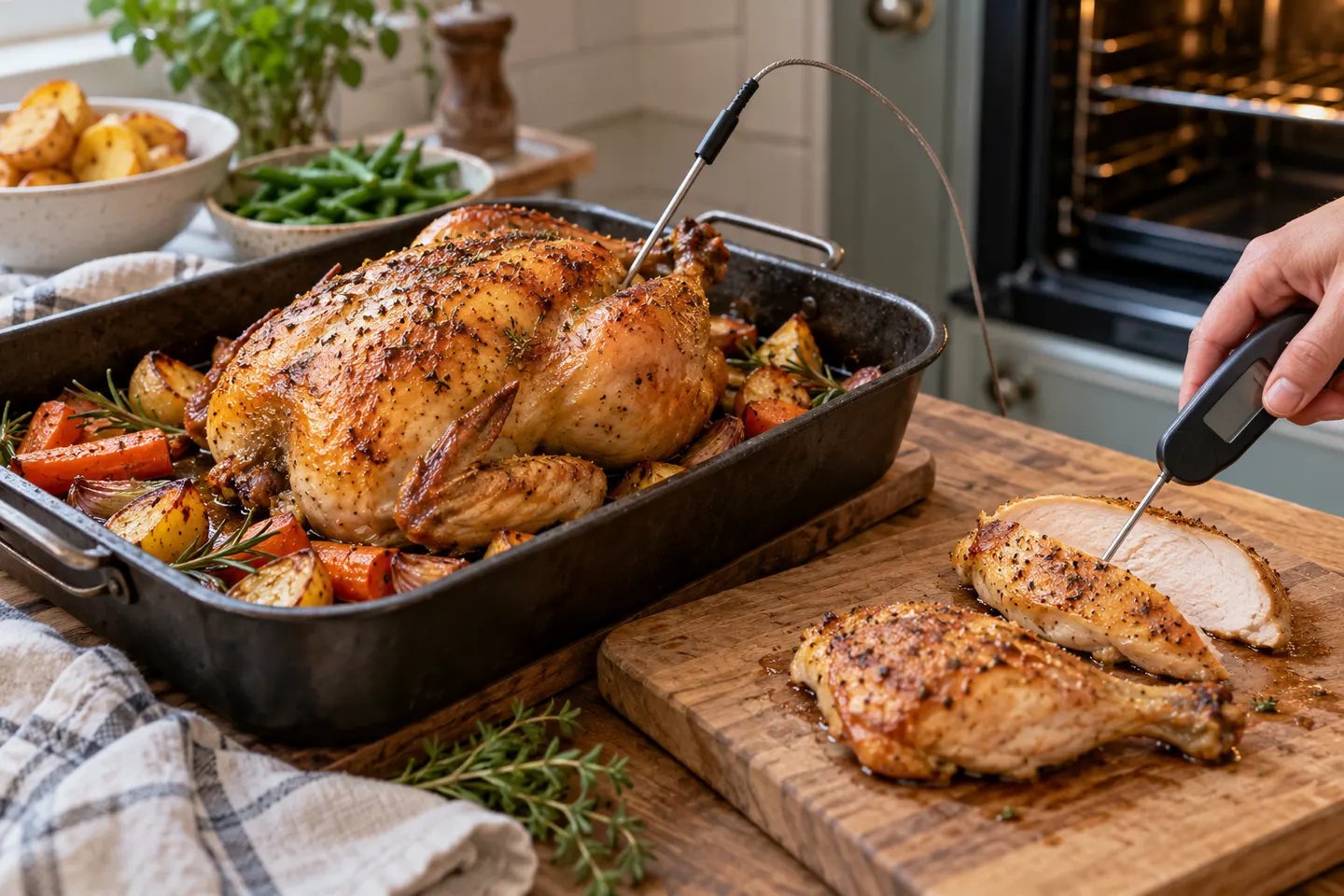
These foods need thorough cooking because contamination can be distributed beyond the surface. Measure the coldest central point and check several locations in large or irregular pieces.
03
Whole cuts of beef, lamb and pork
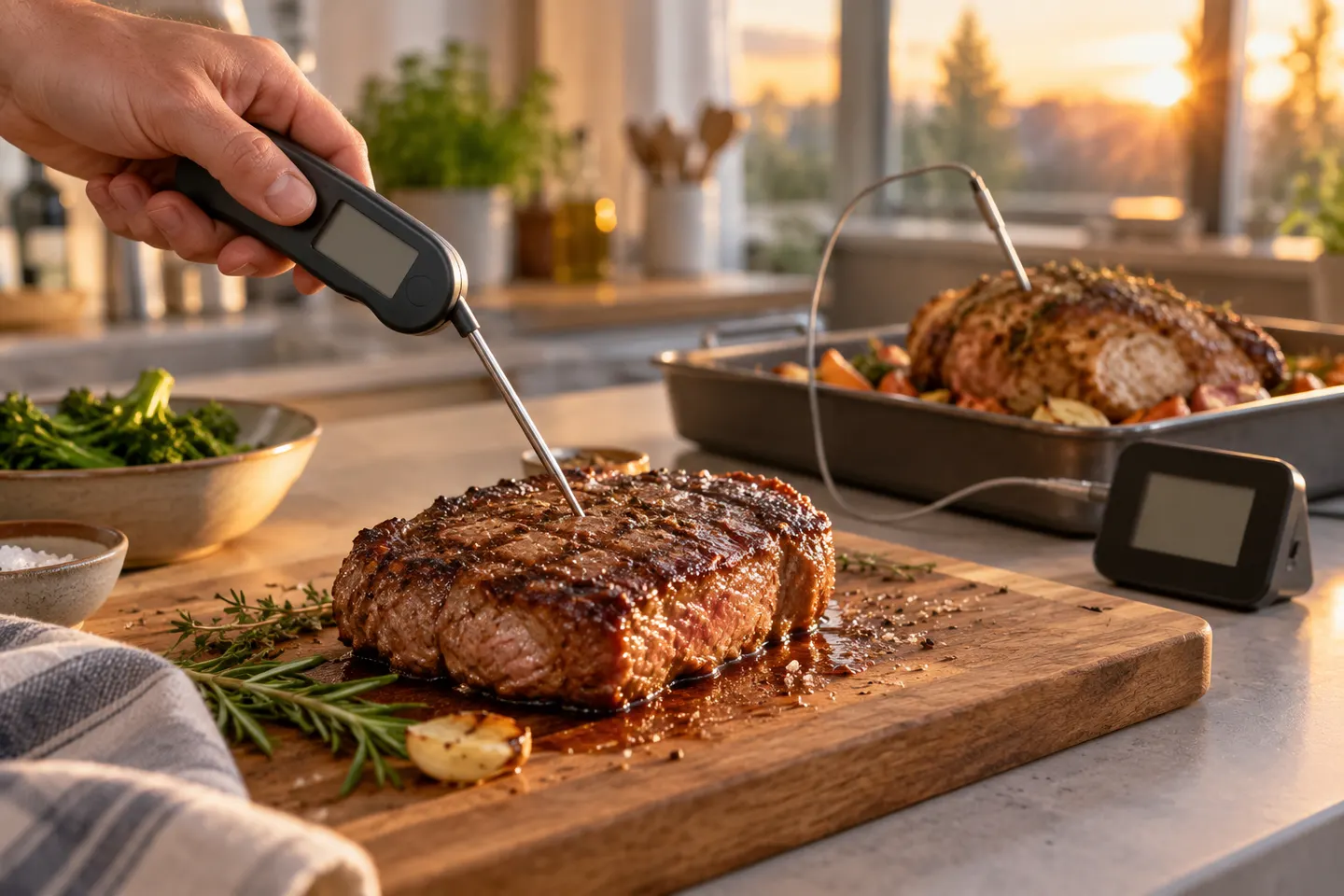
Whole intact cuts differ from mince because contamination is generally associated with the surface. Follow current Australian guidance for the cut, preparation and diner, and remember that tenderised, rolled or stuffed meat needs different treatment.
04
Reheating and hot holding
Reheat food rapidly and measure the centre, then follow local requirements for hot holding. A surface reading cannot demonstrate that the middle has reheated adequately.
05
Chilled food and the danger zone
FSANZ identifies temperatures between five and sixty degrees Celsius as the danger zone for potentially hazardous food. Minimise cumulative time in that range and keep chilled food at five degrees Celsius or colder where required.
06
How to take a dependable reading
Place the probe's sensing area in the thickest or coldest part, away from bone and cookware. Stir liquids where safe, allow the display to stabilise and clean the probe between foods.
Common questions
Questions before you buy
What is a food thermometer chart?
It is a reference for target internal temperatures and holding limits. Use an Australian authority source and apply it to the correct food and process.
What temperature should cooked food reach in Australia?
FSANZ presents seventy-five degrees Celsius at the centre as one cooking option for potentially hazardous food, alongside equivalent validated time-and-temperature combinations.
What is the food temperature danger zone?
FSANZ describes the range between five and sixty degrees Celsius as the danger zone for potentially hazardous food.
Where should I measure food temperature?
Measure the thickest or coldest part, away from bone and the pan. Check more than one point when the food is large or uneven.
A digital probe is the most versatile choice for checking internal food temperature. Choose instant-read for spot checks or a leave-in model for longer cooks.
Your privacy
We use cookies and similar technologies. Necessary ones keep the site working. With your permission we also use statistics cookies (Google Analytics and Microsoft Clarity) to understand which guides help readers. You can accept all, reject all or choose. You can change your choice at any time from "Cookie settings" at the bottom of every page. Cookie policy