Check the model's water-resistance instructions
Before cleaning, identify which parts may be rinsed, washed or placed in a dishwasher. An IP rating on a handheld unit, a waterproof probe and a water-sensitive charging dock are different claims.

Gearjury may earn a commission when you buy through a retailer link. Our editorial choices are based on cited evidence.
Guide
Clean the food-contact probe with hot, soapy water after each use, then dry it thoroughly. Do not immerse the display, transmitter, cable plug or charging dock unless its manual explicitly allows it.
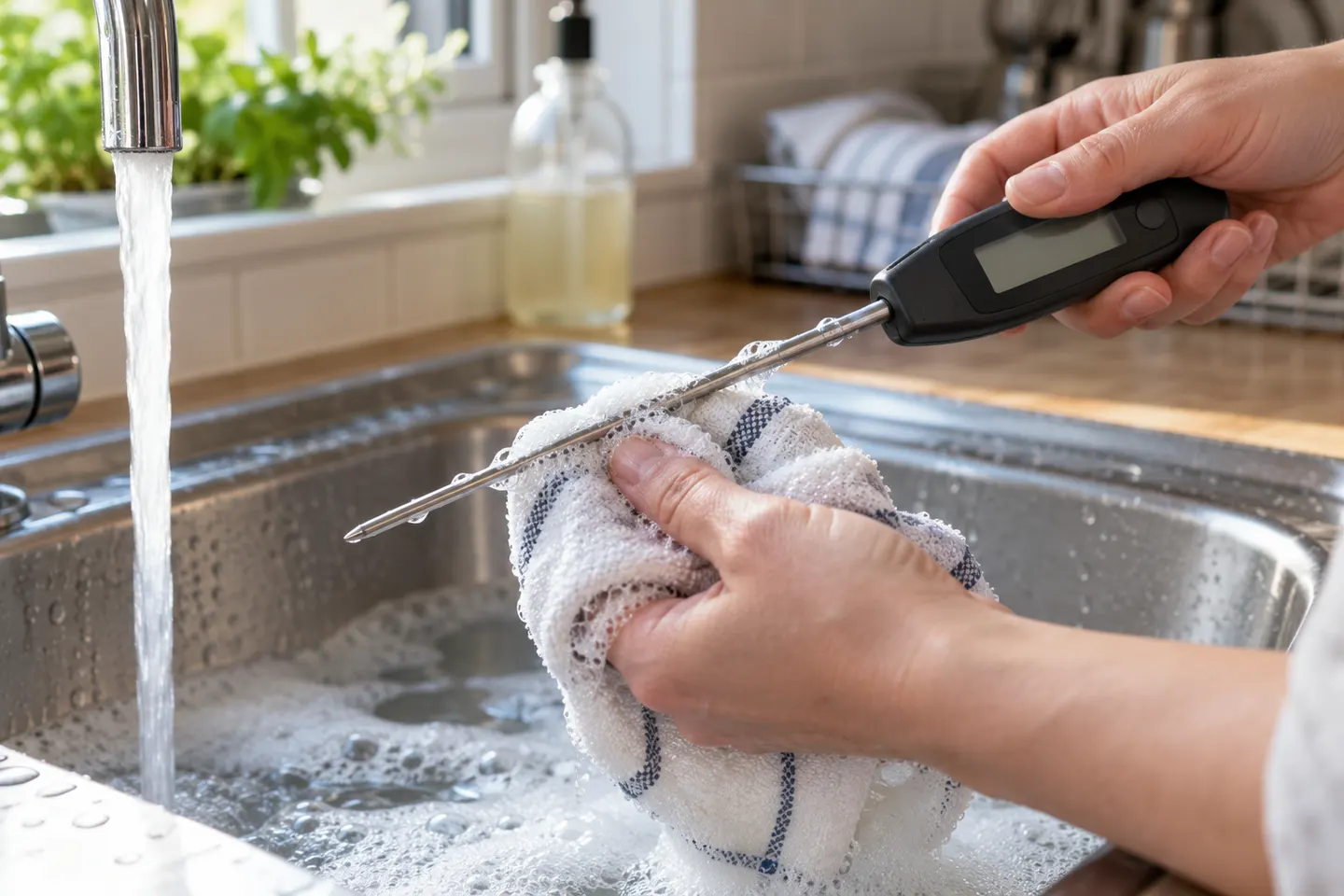
Before cleaning, identify which parts may be rinsed, washed or placed in a dishwasher. An IP rating on a handheld unit, a waterproof probe and a water-sensitive charging dock are different claims.
Wear heat-resistant protection when removing a probe after cooking. Put it on a safe surface until it can be handled without a burn risk, but do not leave food residue to harden unnecessarily.
Use hot, soapy water on the metal probe tip and shaft, keeping liquid away from any unsealed connector, cable joint or electronic body. Remove visible food from the entire insertion area.
Use a lightly damp cloth if the manual permits it. Do not submerge a receiver or base; Maverick's XR-50 instructions specifically keep plugs and transmitter sockets away from water.
Dry the probe, cable and connector thoroughly. Moisture at contacts can interfere with charging or readings, and a damp probe should not be returned to a charging dock.
Avoid moving contamination from raw meat to cooked food. Clean and dry the probe before checking a food that is ready to serve, and follow the federal clean-separate-cook-chill framework.
Common questions
Only if the manual permits that level of water exposure. You can wash the metal food-contact area while protecting an unsealed body, cable joint or plug.
A few removable wireless probes are documented as dishwasher-safe, but many thermometers are not. Follow the exact model instructions.
Clean it between raw and cooked or ready-to-eat food checks to prevent cross-contamination. Follow applicable food-safety guidance and the instrument's care limits.
Drying helps protect contacts and prevents moisture from sitting in a case or charging dock. It also makes the next use cleaner and easier to inspect.