Gearjury may earn a commission when you buy through a retailer link. This does not influence our safety guidance.
Guide
How to Calibrate a Digital Meat Thermometer Safely
To learn how to calibrate a digital meat thermometer, first make a properly packed ice-and-water slurry and check for a stable reading near the expected ice point. Adjust only if the manual provides a calibration control.
GGearjury editorial team · Updated 15 October 2026· 6 min
01
Can you calibrate a digital food thermometer?
Some digital models let you store an offset or enter calibration mode; others can only be checked. Read the manual before pressing button combinations, because reset and calibration commands differ by model.
02
Prepare a true ice-point reference
Fill a container with crushed ice, add just enough clean water to fill the gaps, then stir. The mixture should contain plenty of ice rather than becoming a glass of cold water.
03
Insert the probe correctly
Place the sensing area in the centre of the slurry without touching the sides or bottom. Respect the probe's minimum immersion depth and stir gently so warmer pockets do not distort the check.
04
Wait for a stable reading
Allow the display to settle. At ordinary atmospheric pressure, a correctly prepared ice slurry should be close to 0°C. A small difference may fall within the instrument's published tolerance.
05
Adjust, record or replace
Use the maker's calibration function only when supplied. If the model cannot be adjusted, record a modest stable offset if your food-safety procedure permits it; replace or professionally calibrate a unit that is inconsistent, damaged or outside the allowed tolerance.
06
When should a digital cooking thermometer be checked?
Check after a drop, after exposure beyond its rated range, when readings look implausible and at the interval required by your kitchen's food-safety system. Commercial settings should keep a simple record.
Common questions
Questions before you buy
What temperature should an ice bath read?
A well-prepared ice-and-water slurry should be close to 0°C at ordinary atmospheric pressure. Include the thermometer's stated tolerance when deciding whether it passes.
Why is my digital food thermometer reading incorrectly?
Poor immersion, contact with the container, a weak battery, probe damage or exposure outside its limits can all affect a reading. Repeat the check with a fresh slurry before adjusting it.
Can I calibrate a thermometer with boiling water?
It is possible when the maker permits it, but the expected boiling point changes with altitude and pressure and hot water can scald. Ice-point verification is simpler for routine checks.
How often should a food thermometer be calibrated?
Follow the manufacturer's or your food-safety plan's interval, and check immediately after shock, extreme heat or suspicious readings.
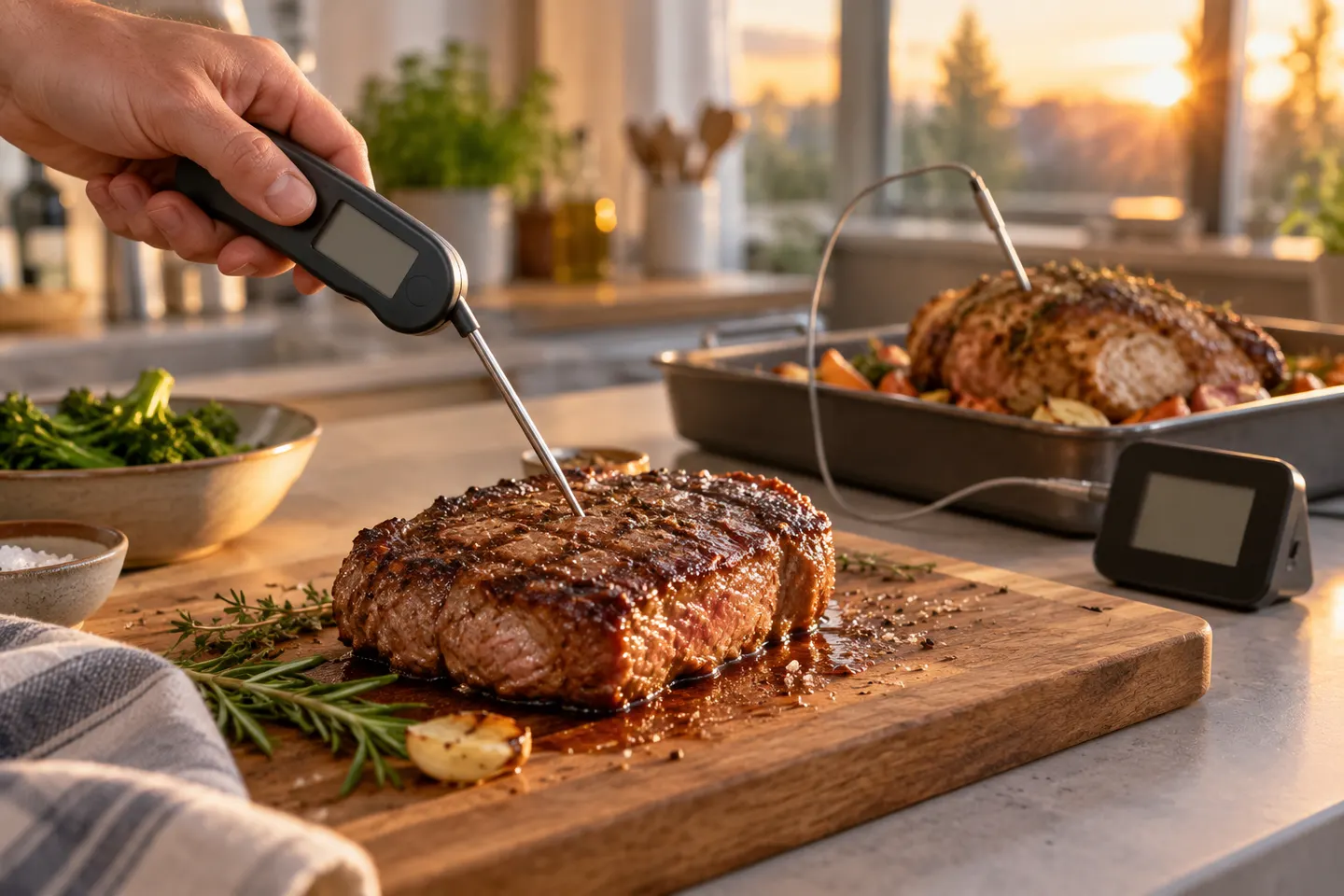
Pick a folding digital thermometer for rapid checks or a leave-in digital probe for alarms during a roast. Accuracy and sensing-tip placement matter more than extra presets.
Thermapen ONE is our top all-round pick for fast spot checks. ThermoPro TP19H is the simpler alternative, while DOT and MEATER Pro suit cooks who need continuous monitoring.
An instant-read thermometer suits quick checks; a leave-in or wireless probe is better for tracking a roast without repeatedly opening the oven.
Your privacy
We use cookies and similar technologies. Necessary ones keep the site working. With your permission we also use statistics cookies (Google Analytics and Microsoft Clarity) to understand which guides help readers. You can accept all, reject all or choose. You can change your choice at any time from "Cookie settings" at the bottom of every page. Cookie policy