Where to put the thermometer in a whole chicken
Check both the deepest breast area and the innermost thigh where it meets the body. Insert into muscle, not the cavity, and stop before the tip reaches bone.

Gearjury may earn a commission from eligible retailer links.
Guide
Put the probe into the thickest part of the breast and the innermost thigh, without touching bone. On a leg quarter, measure the thickest thigh muscle near the joint and confirm more than one spot.
Check both the deepest breast area and the innermost thigh where it meets the body. Insert into muscle, not the cavity, and stop before the tip reaches bone.
Aim for the thickest section of the thigh near the hip joint, approaching from the fleshy side. Because the drumstick and thigh vary in thickness, confirm another location before serving.
For a thick breast, enter from the side so the sensing area reaches the centre. On a thin fillet, side insertion keeps more of the probe inside the food than pushing down from above.
Bone and hot metal can distort the reading. If a number changes sharply as you move the probe a few millimetres, withdraw and reinsert into nearby muscle.
The FSA advises thoroughly cooking poultry and gives 70°C for 2 minutes or an equivalent time-and-temperature combination. Use the lowest credible internal reading, not the first hot spot.
Wash and disinfect the probe according to its instructions before placing it into cooked meat again. Keep raw-poultry utensils away from ready-to-eat food.
Common questions
Insert it into the thickest thigh muscle near the hip joint, avoiding bone. Check a second point because the quarter has uneven thickness.
Check both. The coldest location can vary with bird size, shape, stuffing and cooking method.
No. Bone can produce a misleading reading, so place the sensing area fully in the meat.
The FSA cites 70°C for 2 minutes or an equivalent combination and advises cooking poultry thoroughly. Measure the coldest core location.
Keep exploring

An instant-read thermometer suits quick checks; a leave-in or wireless probe is better for tracking a roast without repeatedly opening the oven.
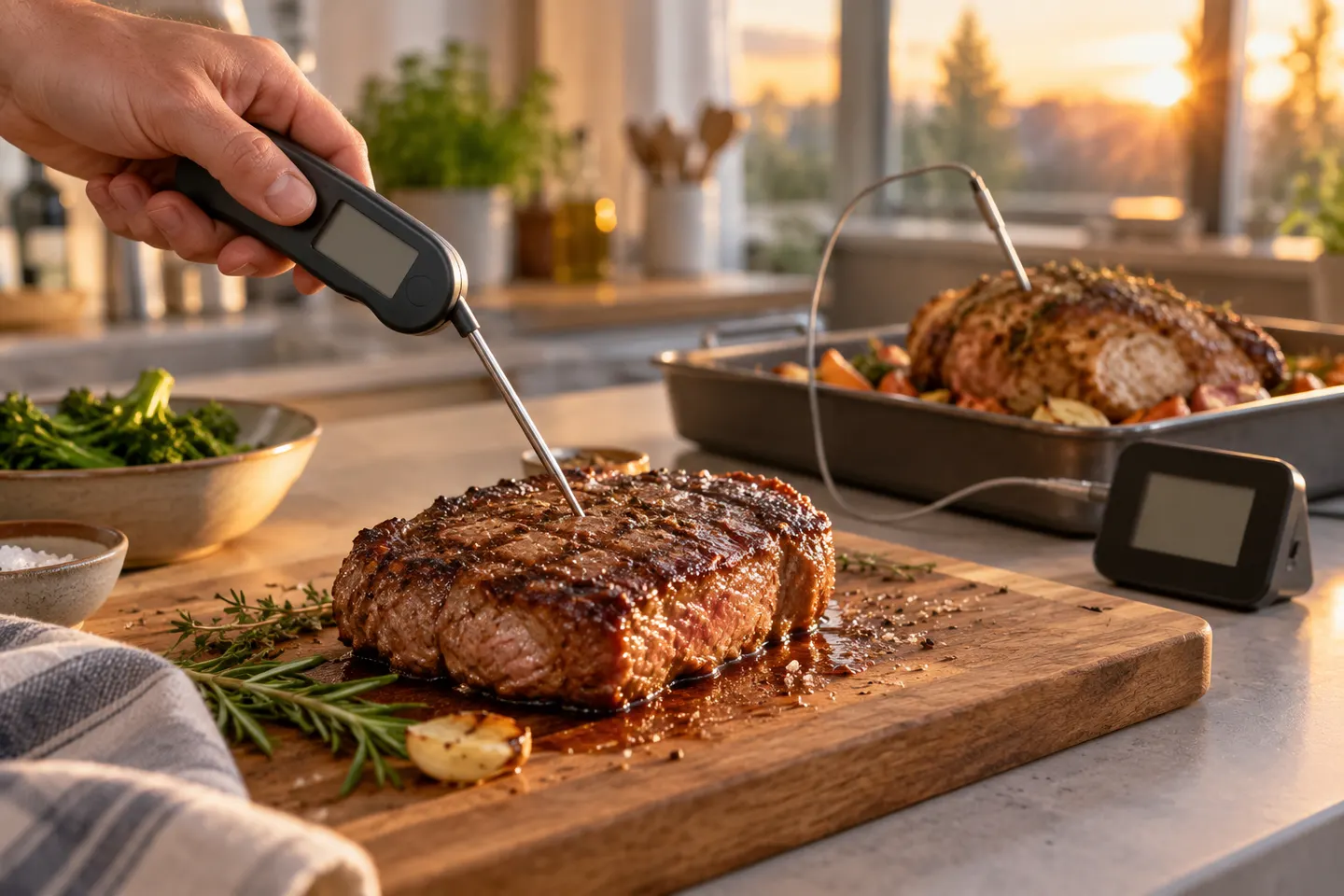
Pick a folding digital thermometer for rapid checks or a leave-in digital probe for alarms during a roast. Accuracy and sensing-tip placement matter more than extra presets.

Thermapen ONE is our top all-round pick for fast spot checks. ThermoPro TP19H is the simpler alternative, while DOT and MEATER Pro suit cooks who need continuous monitoring.