Gearjury may earn a commission from eligible retailer links. This does not change our guidance.
Guide
Cooking Thermometer Temperature Chart for Meat and Food
For home cooking, the Food Standards Agency gives 70°C for 2 minutes or an equivalent time-and-temperature combination. Check the centre or thickest part, away from bone.
GGearjury editorial team · Updated 15 October 2026· 6 min
01
What temperature should cooked food reach?
The FSA advises cooking until the core reaches 70°C for 2 minutes. Equivalent combinations include 75°C for 30 seconds, 80°C for 6 seconds and lower temperatures held for longer. Follow the food's instructions where they set a stricter target.
02
Meat thermometer temperature chart
Poultry, pork products made from minced meat, burgers, sausages, rolled joints, offal and reheated leftovers should be cooked thoroughly. Whole cuts of beef or lamb may be served less cooked only when the exterior has been properly seared and the meat has not been mechanically tenderised or rolled.
03
Where should the probe go?
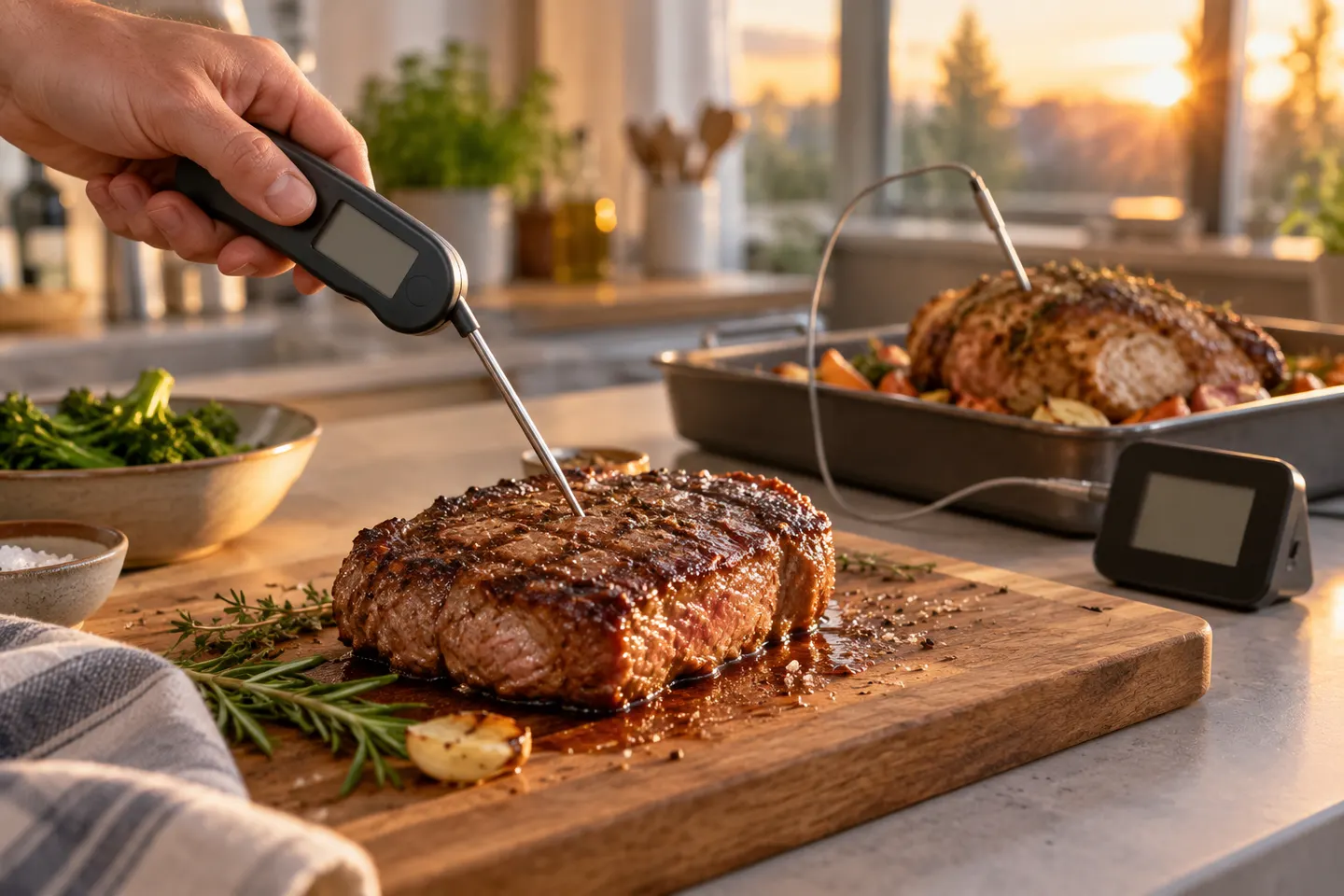
Insert the sensor into the thickest or coldest part. Avoid bone, the pan and large pockets of fat because they can produce a reading that does not represent the food's centre.
04
How long should you hold the temperature?
Safety depends on both temperature and time. A lower validated core temperature requires a longer hold, so do not treat every number on a cooking chart as an instant finish line.
05
How to check several portions
Measure more than one piece when portions differ in size. With a whole bird or large joint, check multiple thick areas and confirm that the coolest reading meets the chosen safe combination.
06
Clean the thermometer between readings
Wash and disinfect the probe as the manufacturer directs, especially after contact with raw meat. Rechecking cooked food with a contaminated probe can transfer bacteria back to it.
Common questions
Questions before you buy
What should a meat thermometer read in the UK?
For home cooking, the FSA gives 70°C for 2 minutes or a validated equivalent combination. Measure the core, not the surface.
Is 75°C safe for cooked food?
The FSA lists 75°C held for 30 seconds as an equivalent cooking combination. Some foods or instructions may require a different approach.
Where is the coldest part of meat?
It is usually near the centre of the thickest section, but shape, bone and stuffing can shift it. Probe more than one place on large or irregular food.
Can colour replace a thermometer reading?
No. Colour and clear juices are useful visual checks, but a clean food thermometer gives a direct core-temperature measurement.
Pick a folding digital thermometer for rapid checks or a leave-in digital probe for alarms during a roast. Accuracy and sensing-tip placement matter more than extra presets.
Thermapen ONE is our top all-round pick for fast spot checks. ThermoPro TP19H is the simpler alternative, while DOT and MEATER Pro suit cooks who need continuous monitoring.
Your privacy
We use cookies and similar technologies. Necessary ones keep the site working. With your permission we also use statistics cookies (Google Analytics and Microsoft Clarity) to understand which guides help readers. You can accept all, reject all or choose. You can change your choice at any time from "Cookie settings" at the bottom of every page. Cookie policy