What is a cooking thermometer?
A cooking thermometer is an instrument for measuring food, liquid, oil, sugar or cooker temperature. The useful type depends on whether you need a quick internal check, continuous monitoring or a surface reading.

Gearjury may earn a commission when you buy through a retailer link. This does not influence our safety guidance.
Guide
A food thermometer measures temperature with a probe or surface sensor. Penetration models check the centre of food; infrared models check only the surface.
A cooking thermometer is an instrument for measuring food, liquid, oil, sugar or cooker temperature. The useful type depends on whether you need a quick internal check, continuous monitoring or a surface reading.
Insert the sensing tip into food, wait for a stable number and remove it. These models are useful for portions, several locations in a joint and foods that cannot keep a probe in place.
An oven-rated probe remains in the food while a cable, receiver or wireless connection carries the reading outside the cooker. Always distinguish the food-sensor limit from the ambient-sensor or cable limit.
An infrared instrument estimates surface temperature without contact. It helps with pans, griddles and chilled surfaces but cannot measure the centre of meat or other thick food.
Aim for the coldest likely point in the thickest section, away from bone, large fat deposits and the pan. Check multiple points in irregular food and approach thin items from the side.
Clean and disinfect the probe between uses, following the water-resistance limits. Verify accuracy periodically and after a drop, then store the tip protected from damage.
Common questions
A meat thermometer is a type of food thermometer. Many digital penetration probes also work for fish, bread, liquids and reheated dishes within their stated range.
It checks whether food or a cooking process has reached a target temperature. Different designs suit internal food, oven air, hot sugar or surfaces.
Only a model or probe explicitly rated for leave-in oven use can remain there. Handheld instant-read bodies normally cannot.
Insert the complete sensing area, which varies by model, into the centre of the food. Check the manual for the sensor location and minimum immersion depth.
Keep exploring
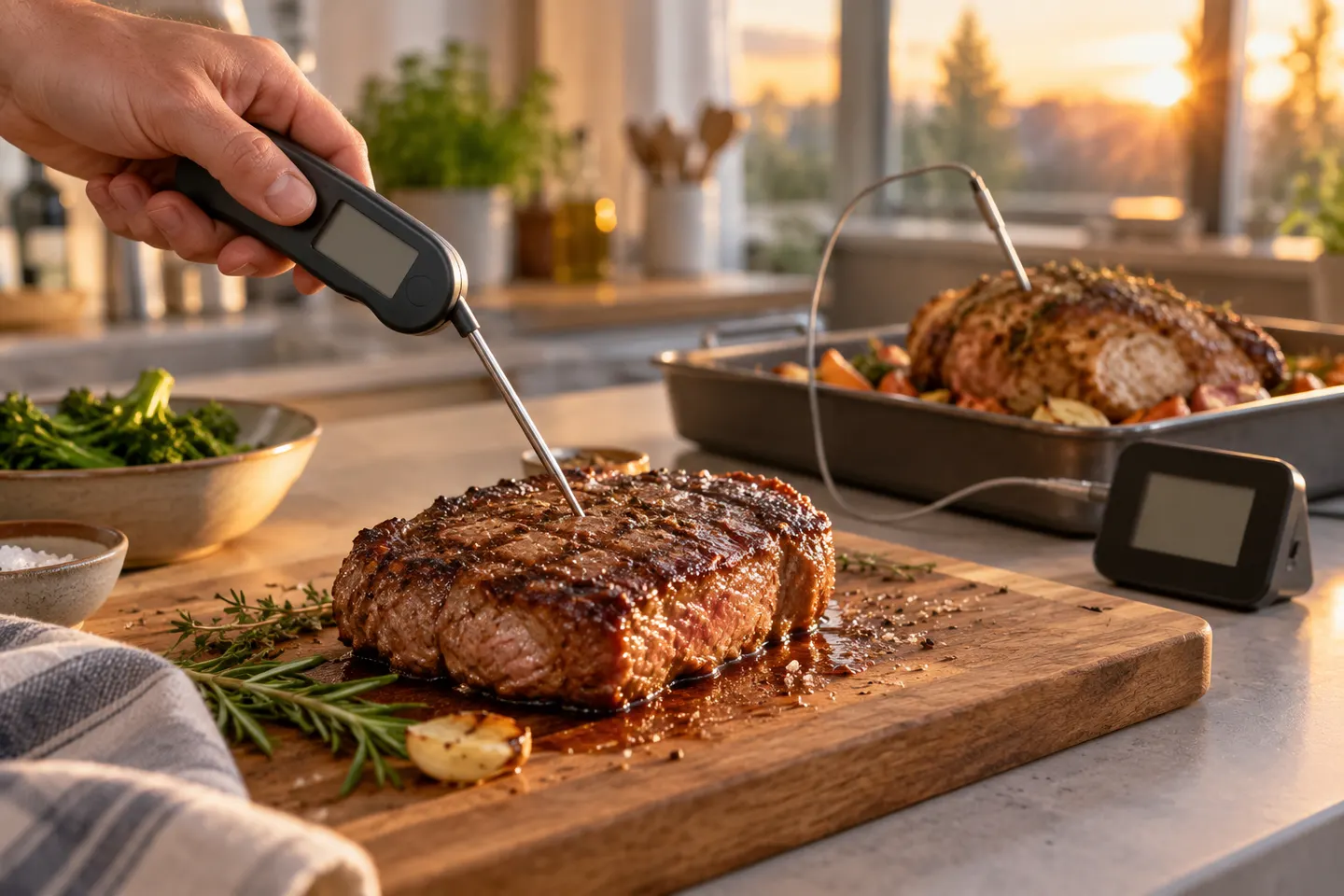
Pick a folding digital thermometer for rapid checks or a leave-in digital probe for alarms during a roast. Accuracy and sensing-tip placement matter more than extra presets.

Thermapen ONE is our top all-round pick for fast spot checks. ThermoPro TP19H is the simpler alternative, while DOT and MEATER Pro suit cooks who need continuous monitoring.

An instant-read thermometer suits quick checks; a leave-in or wireless probe is better for tracking a roast without repeatedly opening the oven.