Gearjury may earn a commission when you buy through a retailer link. Editorial conclusions are based on cited evidence.
Guide
How Does an Air Purifier Work?
A fan draws room air through one or more filters and returns it to the room. Filter type tells you what it targets; CADR tells you how quickly it delivers filtered air for particles.
GGearjury editorial team · Updated 14 October 2026· 4 min
01
The basic airflow loop
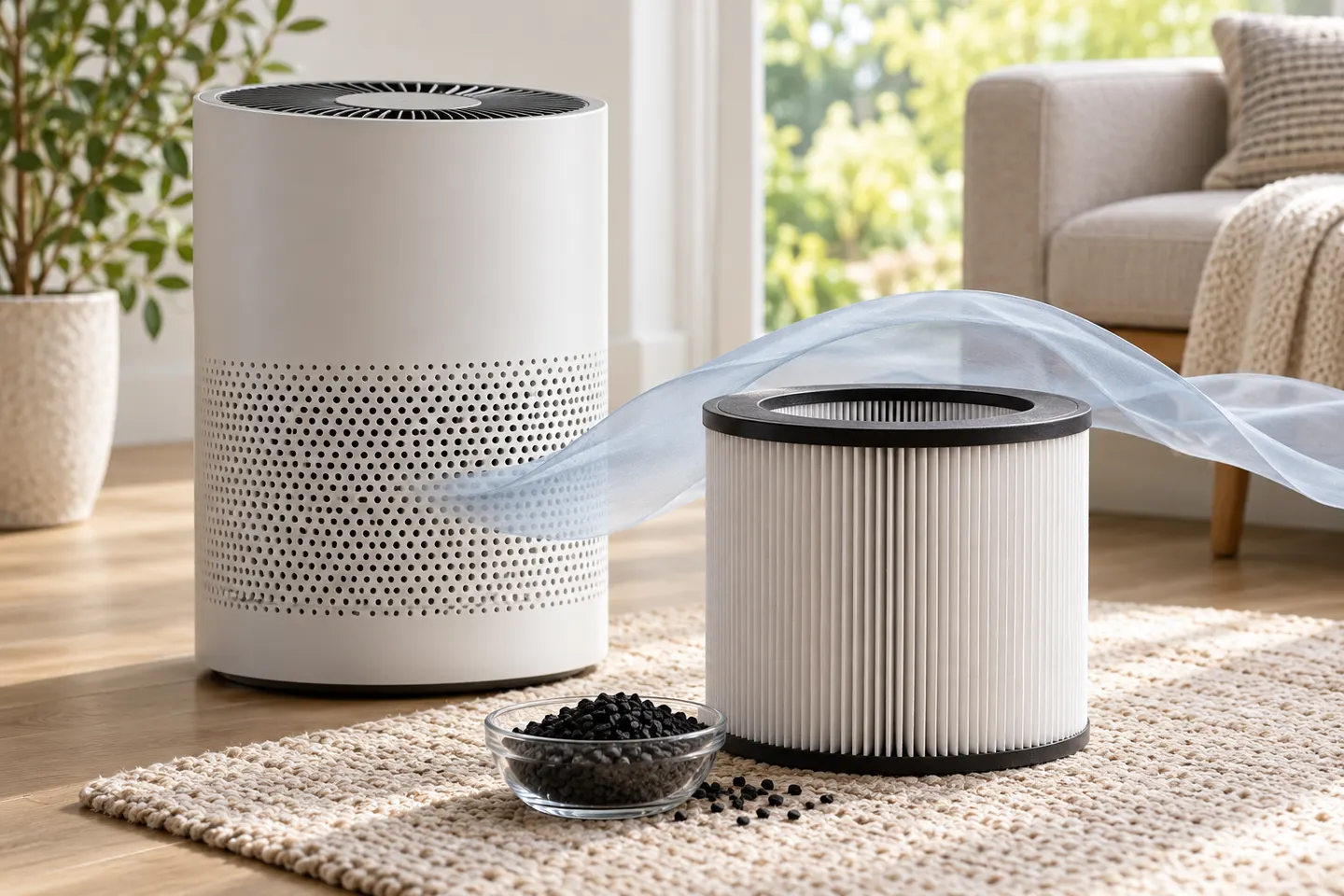
A portable purifier pulls nearby room air through an intake, passes it through a filter stack and pushes it back out. Repeating that loop gradually filters the air that reaches the unit. Blocked intakes, dirty filters and low fan speed reduce the amount of air processed.
02
Pre-filters, HEPA and carbon
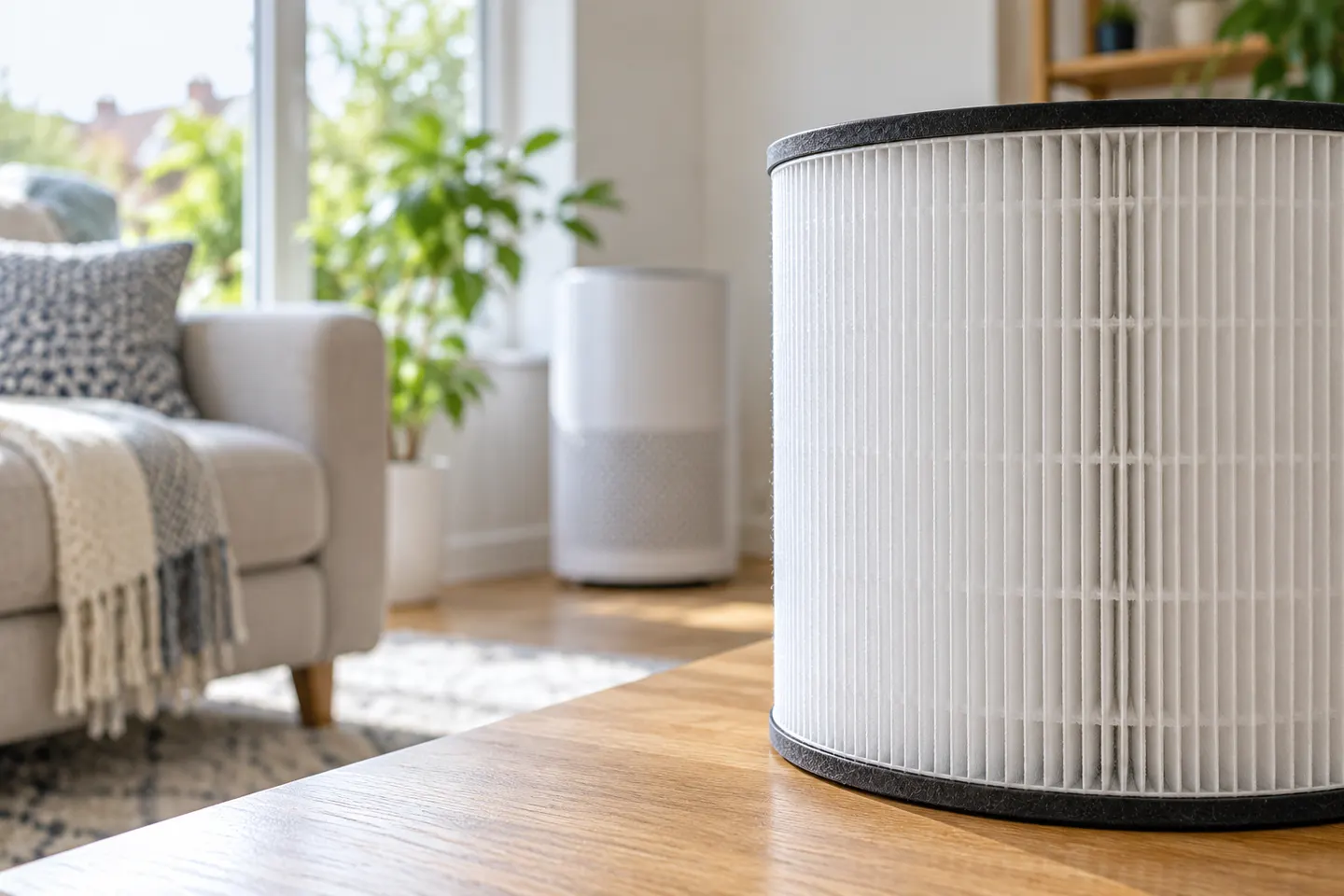
A pre-filter catches larger debris and protects later stages. HEPA-class filters target particles. Activated carbon targets selected gases and odours; the EPA notes that effectiveness depends on using a large amount of material. Particle CADR does not measure gas removal.
03
What CADR means
Clean air delivery rate combines airflow and particle-removal efficiency into a delivery figure. Higher CADR can serve a larger room or provide more air changes, but compare the same particle and units. CADR is commonly published in cubic metres per hour or cubic feet per minute.
04
How to estimate air changes
Multiply room length, width and height to get volume. Divide CADR in m³/h by room volume in m³ to estimate air changes per hour before allowing for real-world leakage and placement. Example: 240 m³/h divided by a 48 m³ room equals 5 theoretical air changes per hour.
05
Ionic and UV systems
Ionisers charge particles; some electronic systems can produce ozone. UV can inactivate some organisms only with enough dose and exposure time. Neither label replaces evidence for the exact product, and neither should be treated as a reason to ignore ventilation or source control.
Common questions
Questions before you buy
How does a HEPA air purifier work?
A fan moves room air through a high-efficiency particle filter. The result depends on filter class, airflow, room size and how long the unit runs.
What does activated carbon do?
It adsorbs selected gases and odours. Capacity depends on the carbon formulation and amount; particle CADR does not rate gas removal.
How do I calculate CADR for my room?
Estimate room volume in cubic metres, choose a target number of air changes per hour and multiply the two. Compare the result with a CADR in m³/h.
Are ionising air purifiers safe?
Some ionising or electronic cleaners can emit ozone. Check independent ozone-safety evidence and avoid devices intentionally designed to produce ozone.
Winix identifies Filter O for the Zero Compact as H13 HEPA. The other four models have useful particle-filtration claims, but their supplied manufacturer pages do not establish H13 or an equivalent filter class.
Compare air purifiers for UK homes by room size, noise and upkeep, then choose the buying guide, shortlist or model comparison that fits your decision.