Gearjury may earn a commission from qualifying retailer links.
Guide
How Does a Radar Detector Work? Signals and Alerts Explained
A radar detector scans for supported radio signals and alerts when it senses energy within configured bands. It cannot identify every speed-measurement method or promise advance warning.
GGearjury editorial team · Updated October 19, 2026· 5 min
01
What signal does the detector look for?
Police radar equipment can transmit radio-frequency energy in supported bands. A detector’s antenna receives energy within the bands enabled for that model; manufacturer documentation lists its supported ranges.
02
How does a radar alert happen?
The device processes received energy and presents an audible or visual warning. Signal strength and alert timing depend on the source, surroundings, detector placement and settings.
03
Why can alerts be false?
Other electronic sources can produce energy that resembles a supported radar band. Filtering tools may reduce nuisance alerts, but consult the manual to understand their effect.
04
Does a detector find laser or speed cameras?
Some models include laser reception, but laser detection has different limitations from radar sensing. A camera database or GPS alert is another feature and depends on maintained data.
05
What can’t it tell you?
An alert does not prove which device caused the signal, reveal a guaranteed distance or replace checking your speed. It may not detect every enforcement method or provide advance warning.
Common questions
Questions before you buy
How does a police radar detector work?
It receives energy in supported radar bands and alerts when its processing identifies a signal. Detection and alert timing are not guaranteed.
Can a radar detector detect a speed camera?
Only if the camera system uses a signal the detector can sense; some camera systems use other methods. GPS alerts, when present, rely on a separate location database.
Why does my detector beep when there is no police nearby?
Electronic equipment can trigger an alert, and the detector may not identify its source. Review the model’s filtering settings and manual.
Does a radar detector work against laser?
Some detectors include laser reception, but laser operation differs from radar and an alert may arrive too late to provide useful advance notice.
K band is a microwave radar frequency range used by some speed-measuring equipment. A detector can alert to energy in that range, but an alert alone does not identify its source.
The Uniden R8 pairs dual low-noise amplifiers with front and rear directional awareness. Compare it with the R7 and R4 by the features documented for each model.
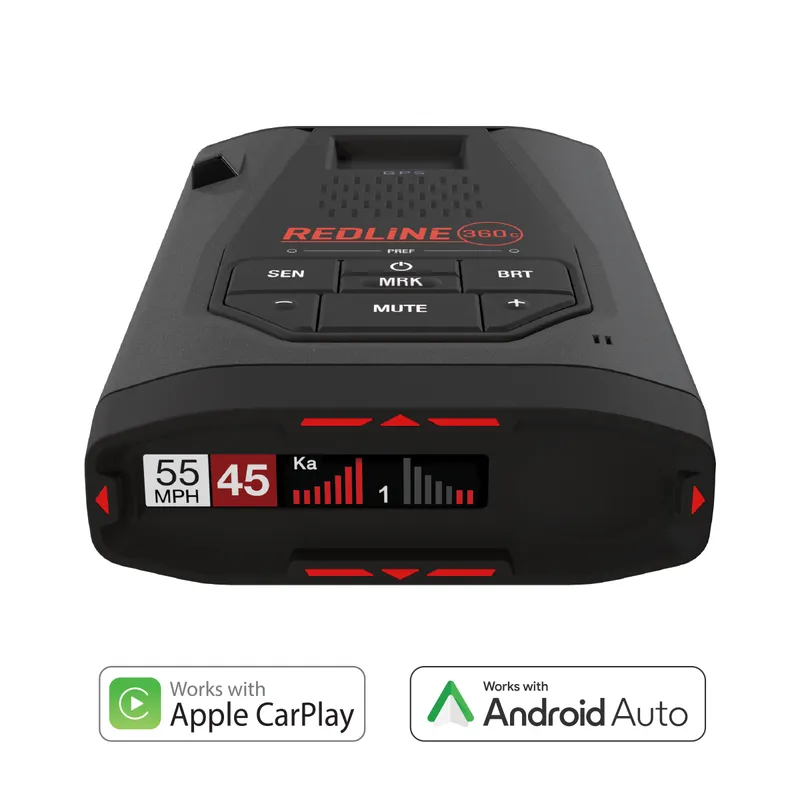
Escort’s Redline 360c lists a three-antenna design, while the MAX 360c MKII uses a dual-antenna platform. Compare the published features and check the exact generation before buying.
Your privacy
We use cookies and similar technologies. Necessary ones keep the site working. With your permission we also use statistics cookies (Google Analytics and Microsoft Clarity) to understand which guides help readers. You can accept all, reject all or choose. You can change your choice at any time from "Cookie settings" at the bottom of every page. Cookie policy