Why advertised range is not a room-by-room promise
Wireless coverage changes with the building and network. A manufacturer's rate or coverage illustration is not a guarantee that a particular extender will reach a stated distance through your walls.

 Best picksBest WiFi Extenders in the UK: Compare Five Practical Options
 Best picksThe Best Dashcams in the UK for 2026
 Best picksBest Portable Air Coolers: Five Models to Compare for 2026
 Best picksBest Meat Thermometers in the UK for 2026
 Best picksBest Headlamp Torches in the UK: Five Choices for 2026
 Best picksBest Winter Gloves in the UK: Five Activity-Based Choices for 2026
 Best picksBest Radar Detectors in the UK: Models Compared for 2026
 Best picksBest Value Cordless Strimmers in the UK (2026)
 Best picksBest Air Purifiers in the UK for Different Rooms and Needs
We may earn a commission from qualifying retailer links.
Guide
There is no single reliable distance: an extender rebroadcasts the connection it receives, so walls, interference, frequency band and placement all matter. Start with a strong link to the router, then test the far room.
Wireless coverage changes with the building and network. A manufacturer's rate or coverage illustration is not a guarantee that a particular extender will reach a stated distance through your walls.
An extender can only repeat the signal it receives. If the connection back to the router is weak, devices connected to the extender may also experience a weak or unstable link. Place the unit partway towards the problem area, not deep inside it.
Dense masonry, foil-backed insulation, metal appliances and multiple floors can reduce signal. Open-plan rooms often behave differently from narrow hallways with several intervening walls, so measure your own layout rather than relying on a universal metre figure.
In general, 2.4 GHz can be more useful through obstacles and over distance, while 5 GHz can offer more capacity at shorter range. Actual behaviour depends on interference, device support and the extender's radio design.
Many models provide a light or app signal check to help identify a suitable position. After setup, test browsing or streaming in the target room at the times you normally use it; reposition the extender if the router link indicator is poor.
For several floors, multiple dead zones or a long building, a mesh system or an access point connected by Ethernet may be more suitable than daisy-chaining extenders. The right option depends on whether you can run a cable and what your router supports.
Common questions
No fixed doubling can be promised. It creates another coverage point, but the result depends on the signal reaching the extender and the obstacles between it, the router and your devices.
2.4 GHz often travels through obstacles more effectively, while 5 GHz can provide more capacity over shorter distances. The best band depends on local interference, walls and the devices being connected.
Place it roughly between the router and the weak area, where the router signal is still usable. Use the model's signal indicator if available, then verify coverage in the actual room.
It might extend coverage towards a nearby outdoor area if it has a suitable indoor signal and the building layout allows it. Exterior walls and distance can make performance unpredictable; use outdoor-rated equipment where exposure to weather is involved.
Keep exploring
TP-Link RE315 is a practical starting point for a standard indoor dead zone. Consider a Wi-Fi 6 device for newer kit, outdoor-rated hardware for a garden, or powerline where a wireless hop struggles.
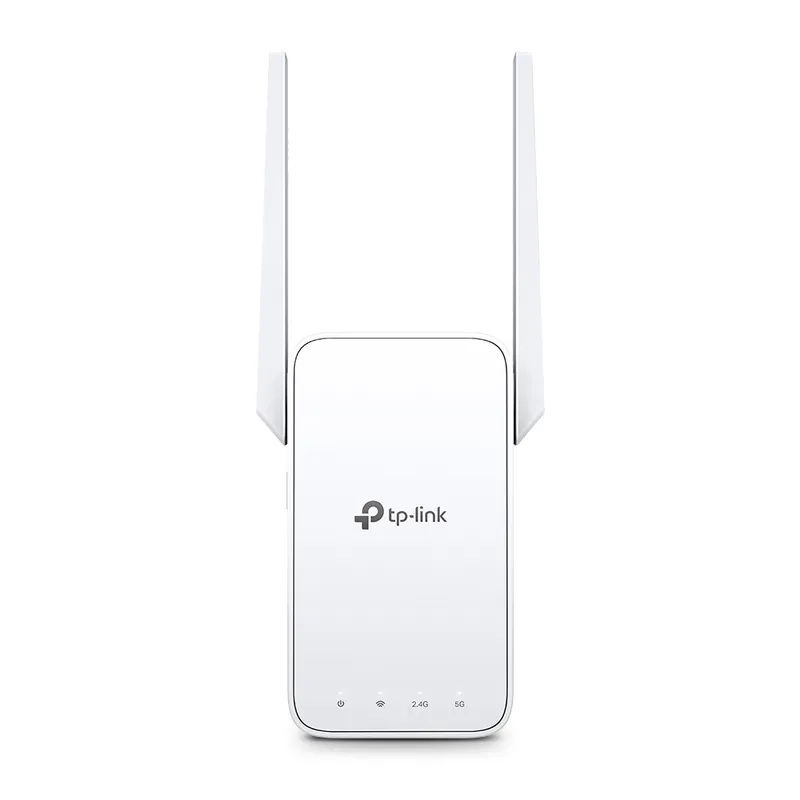
TP-Link sells plug-in repeaters and powerline kits. Check EasyMesh support, Ethernet needs and the exact UK hardware revision before buying.

Sky has different booster products for different broadband generations. Sky Max customers may use a Max Pod; check your account and hub-specific help before seeking a third-party extender.

A WiFi extender can carry your router signal further, but placement and backhaul matter. Choose a plug-in repeater for a nearby dead zone, powerline WiFi for difficult layouts, or an outdoor-rated unit for a garden.