Gearjury may earn a commission from retailer links. This does not affect our editorial guidance.
Guide
WiFi Booster: How Do They Work to Extend Your Signal?
A WiFi booster, commonly called a range extender, connects to your router’s existing wireless network and relays it to improve reach. It can help beyond a dead spot, but it cannot create extra broadband capacity or repair a weak connection coming into the home.
GGearjury editorial team · Updated 18 October 2026· 4 min
01
How a range extender relays the router signal
A WiFi range extender joins the router’s wireless network, receives its signal and transmits a connection into a further area. Devices then connect through the extended coverage. This is why placement matters: the extender needs a reasonable signal from the router before it can relay it.
02
WiFi booster and range extender mean much the same thing
Retailers and broadband providers use ‘booster’ informally for equipment that improves coverage. It may be a wireless range extender, a mesh node, a powerline kit or an access point. Check how the specific device links back to the router before comparing it with another product.
03
Why an extender may not increase your broadband speed
The extender works with the connection it receives from the router. Distance, walls, interference, shared wireless airtime and the router’s internet connection can all constrain performance. A stronger signal icon in a far room does not guarantee a faster internet connection.
04
Where to place a WiFi signal booster
Start between the router and the area with weak coverage, in a position where a phone still receives a stable router signal. The dead zone itself is usually too far away. Move the extender in small steps and check the connection in the target room.
05
When mesh or a wired access point makes more sense
A single extender can address a local gap. Mesh systems coordinate several nodes under one network and can suit a larger home with multiple weak areas. Where Ethernet is available, a wired access point avoids relying on a wireless backhaul for that link.
06
Set up and secure the extended network
Use the maker’s app, browser setup or WPS only if both devices support the chosen method. Keep network security enabled, use the same settings recommended by the router maker and install firmware updates from official support channels.
Common questions
Questions before you buy
Do WiFi boosters create a new internet connection?
No. A wireless booster relays the connection from your router; it does not provide a separate broadband line or fix an outage at the provider.
How does a WiFi signal booster work through walls?
It receives the router’s radio signal and retransmits it, but walls and building materials can weaken both links. Place it where the router signal remains usable, rather than inside the dead zone.
Does a WiFi range extender reduce speed?
It can lower throughput because it shares wireless airtime and depends on the quality of its link to the router. The result varies with the model, placement, band and network conditions.
Can I connect one WiFi booster to another?
Some models support chained extenders, but the additional wireless hop can reduce performance and complicate roaming. Check the manufacturer’s guidance; a mesh system or wired access point may be a better fit.
Should I choose an extender or a mesh system?
Choose an extender for a local coverage gap when a suitable router signal reaches its position. Consider mesh for several rooms or floors where coordinated coverage is more useful.
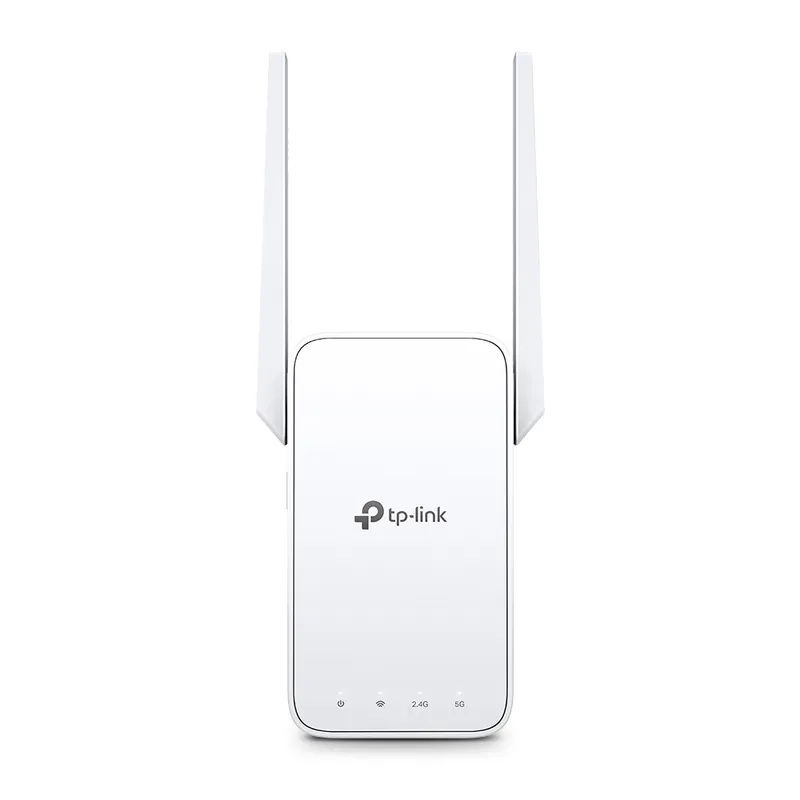
TP-Link RE315 is a practical starting point for a standard indoor dead zone. Consider a Wi-Fi 6 device for newer kit, outdoor-rated hardware for a garden, or powerline where a wireless hop struggles.
Sky has different booster products for different broadband generations. Sky Max customers may use a Max Pod; check your account and hub-specific help before seeking a third-party extender.
A WiFi extender can carry your router signal further, but placement and backhaul matter. Choose a plug-in repeater for a nearby dead zone, powerline WiFi for difficult layouts, or an outdoor-rated unit for a garden.
Your privacy
We use cookies and similar technologies. Necessary ones keep the site working. With your permission we also use statistics cookies (Google Analytics and Microsoft Clarity) to understand which guides help readers. You can accept all, reject all or choose. You can change your choice at any time from "Cookie settings" at the bottom of every page. Cookie policy